I used to be one of those people that took A LOT of time to find a good laptop. I researched every option, quantified every aspect I could and compared every option in a spreadsheet. I am making it sound as if I don’t do it anymore – actually, I still follow this process for my major purchases since it is the best way. But now, I know what I need to focus and what is non-essential. The same process can be applied when searching for the best laptop for engineering.
In this post, I’ll outline the key qualities and metrics you need to know to get the best deal possible. At the end, I’ll list out the top 5 options that I’ve found out by comparing every laptop on my extensive list of hottest and best selling models.
What is needed to get the best engineering student laptop?
For the most part, you can’t expect your university to give precise guidelines to an engineering laptop. Even if your college website gives a description of what laptop you need – they make it sound as if any laptop that has a screen and a processor made in the 2000s should be just fine. At the same time, some websites recommend workstation notebooks which are way over most students budget. These machines are needed only if you’re already a professional. But if you get a professional workstation now and you do not intend to fully utilize it right now – it’s a waste of money that could be put better elsewhere.
Performance and speed
Major requirementProcessor
Here are the processors you should expect at every price range:
Remember that the higher you go on the processor ladder, the shorter battery life you’ll get. That’s why you might not want to go up to the most powerful processors in i7 x800 or x900 lines.
2 processors that dominate the laptop market right now are:
i7-6500U – ($700 and up) above average performance and good battery runtime
i7-6700HQ – ($960 and up) very good performance and shorter battery runtime
Any processor in i7 series and some higher-end i5 processors is fast enough for engineering students.
The best laptop for photography should have a good balance of performance (for editing), high-quality screen and portability.
In the next 5 minutes, I will cover all bases that need to be addressed to pick your own best laptop for photography. I will also list out what you should expect at various price ranges.
At the end, I’ll list out 5 best picks when it comes to best laptops for photography. To find them, I went over a 120 hottest laptops and evaluated them using an array of metrics and benchmarks starting from the processor and ending with every important display metric: panel, resolution, brightness, contrast, sRGB/RGB coverage.
Requirements for the best laptop for photography
I have conveniently split requirements into 3 groups: 3 Major, 3 Minor, and a single Optional demand. Depending on your personal needs, these can be re-ordered or even thrown out. But most could blindly stick with these exact requirements without risking of making a wrong choice.
What is critical for photography laptop?
Major requirement A lot of storage (fast) space
Types of drives
Whenever you’re checking out a laptop, one of the very first you should look at is its storage type. There are 2 most general types of storage and a few options in-between.
First and foremost, SSD is the king when it comes to storage drives. It is the single most impactful advance when it comes to consumer computer parts in the past 10 years. That’s because they’re head and shoulders above the older HDD drives. Solid State Drives are tremendously faster, they consume less power and they do not degrade in performance as HDDs do. But there is one very relevant caveat when it comes to these drives – their price. SSDs are quite a bit cheaper when looking at their price tags from a few years back but they’re still a lot more expensive than their HDD counterparts.
Storage size
Type
500 GB
1000 GB
2000 GB
HDD
$35
$55
$95
SSD
$200
$400
$850
Not surprisingly, a complete opposite could be said about Hard Drive Disks. They are redundantly cheap and best suited for long-term storage. If you are searching for a stationary computer – this would be the end of the story when it comes to drives. Get 500 GB in SSD for the system, photo editing apps and your recent pictures. Then, add 2 TB in HDD for image archives and forget about all storage limits.
The reason why this won’t (usually) work for laptops stems from their size limits. Only 17.3″ owners could brag about their 3 or 4 installed drives. Now, many 15-inch notebooks have very limited options for additional storage. Most likely, they have 1 drive slot and mSATA or M.2 connection. In some cases, manufacturers, striving for ever slimmer and lighter laptops, completely moved to M.2 drives which are only suitable for SSDs.
At the end of the day, you need to choose:
A lot of cheap and slow storage
A small-ish SSD and a spacious HDD in a 15″-17″ laptop
A large SSD in an expensive laptop
What to expect
13.3″
15.6″
17.3″
Under $1000
250 GB SSD
250 GB SSD + 1 TB HDD
250 GB SSD + 1 TB HDD
Under $1500
500 GB SSD
500 GB SSD + 1 TB HDD
500 GB SSD + 1 TB HDD
Over $1500
500 GB SSD
500 GB SSD + 1 TB HDD
500 TB SSD + 1 TB HDD
One more thing, you could get a small external drive over USB 3.0 later down the road, when you’ll be certain that you need one. UBS 3.0 drives are sufficiently fast to not notice a difference. There’s always a cloud storage option, but I would only use them for back-ups. Even with a 100 Mbps internet, they’re still not convenient at all when working with high-resolution RAW images.
Finding the best laptop for photo and video editing requires balancing a lot of power-hungry components with a top-notch screen while keeping a personal budget in the equation.
And it gets even more complicated.
When you need a lightweight machine that can run for hours on its battery alone while still being able to provide the smoothest workflow.
In this post, I will describe what you need to look for EXACTLY in a notebook for creative work and what you should expect at your price range to the dollar.
Finally, I’ll list out 7 best options when it comes to best laptops for video and photo editing. To pick them out, I went over a 100 hottest laptops and evaluated them using specs and benchmarks that took me days to find and collect.
What are we looking for in a photo and video editing laptop?
What is essential for the best laptop for photo and video editing?
Major requirement SSD
How much storage do I need?
You need to decide on the total amount of storage that you’ll need. A basic starting point should be 500 GB. But if I were you, I would advise going up to 1 TB or more.
Do I need an SSD?
Yes. I recommend getting at least a small 250 GB SSD for OS, Photoshop, Lightroom or your favorite photo editing app and several “hot” photo folders. It will make a world of difference. When I edit photos, I notice a measurable difference between my files on SSD and HDD. And I don’t have to work with super high-resolution uncompressed RAW images that would benefit the most from an SSD.
But the main issue with laptop SSDs is that there aren’t many laptops that come with 1 TB SSD built-in. That’s why sometimes you’ll need to limit yourself to 500 GB + 1 TB setup or you’ll need to spend ~$320 for 1 TB SSD.
What should be my target?
At the end of the day, everything revolves around two variables:
Size of a desired laptop
Your spending budget
That’s what I would recommend and what you should optimistically expect:
13-inch
15-inch
17-inch
Under $1000
250 GB SSD + external storage
250 GB SSD + 1 TB HDD
250 GB SSD + 1 TB HDD
Under $1500
500 GB SSD
500 GB SSD + 1 TB HDD
500 GB SSD + 1 TB HDD
Over $1500
500 GB SSD + external storage
500 GB SSD + 1 TB HDD
1 TB SSD + 1 TB HDD
The good part with 15.6″ and 17.3″ laptops is that they often have 2 or 3 slots for storage. That allows easy upgrades in the future.
So you are searching for the best laptop for law school? The good news is that you do not need to spend a lot for an OK computer. But if you want the best one for your needs and wallet – there is only a handful of options I can recommend.
In this page, I will cover everything you need to know about getting a laptop for law school: essential parts of a laptop you should focus on, what is not so important and what are my top 5 picks ($170 to $2100) for any law school student.
What are the requirements for law school laptop?
I have isolated 3 major requirements that would make any laptop a solid choice. Then I have 5 minor requirements that would make sure the notebook we are getting is well-suited for law school and student life in general.
What is essential for the best laptop for law school?
Major requirement Storage
I think, SSD is my most used abbreviation. And for a good reason. Even now I get a bit excited when seeing how quickly every app starts up and how little time I need to find a missing document. SSD is the cure from my trauma of slow computers and hard drives breaking down since Windows 98 era.
If you have been living under HDD rock and you do not know what an SSD is – I can break it down to a few very basic rules of thumb. SSD is a different type of a storage drive that offers a tremendous improvement in overall speed and general experience when using a computer. In the past ~5 years, these drives have become a lot cheaper and viable option compared to their older HDD counterparts. And now, these SSD drives are becoming the standard. Yet, there still are many notebooks in every price range that do not have an SSD. In short, getting an SSD over HDD is be the investment to a computer’s performance you could make.
To understand what you should expect from a laptop, here’s my guideline after comparing ~130 laptops on the market:
Under $700: regular hard drive
$700 to $1000: small SSD storage (250 GB)
$1000 and up: medium SSD storage (500 GB) with possible additional 1 TB HDD
Depending on a laptop’s size, there are various options to upgrade a laptop in the future, so do not worry too much to get this requirement one a bit wrong. Unlike processors or graphics chips, storage drives are easy to replace or upgrade, especially in large 15-to-17-inch computers. With smaller ones, I would be more cautious and I would try to get my preferred setup already built-in.
The best laptop for word processing and excel doesn’t mean that should be expensive. At the same time, when brands release entry-level laptops, they are forced to make some strong compromises. And I won’t shock you by saying that some laptops have made very bad ones.
That’s why getting a first cheap laptop off the shelve will not work. Or at least, you’ll have a worse laptop than you could have. And I don’t know much about you, but I hate knowing I could have found a better deal and I didn’t due to my own fault.
That’s why I’ll share my knowledge on finding the best cheapest laptops for word processing and best laptops for excel. First, I’ll outline the requirements that will narrow our focus to the essentials and at the end, I’ll reveal the best cheap laptops for every price range.
Let’s dive right in.
What are we searching for in a word processing and excel laptop?
There are not many things you can get wrong with when buying a computer for Word, Excel, and other basic office software. But if you want to get the best cheap laptop for word processing and the internet, you’ll need to spend your money just in the right areas and ignore the rest.
What is essential for the best laptop for word processing?
Major requirement Mid-range processor
There are 2 key parts when considering general laptop experience: a processor and hard drive.
Under $400: basic processor and regular hard drive
$400 to $700: mid-range processor and regular hard drive
$700 to $1000: good processor small SSD storage
$1000 and up: good processor large SSD storage
You probably noticed, that I slightly prioritize a better processor. That’s because a hard drive can be replaced, upgraded or at least defragmented if it is becoming frustratingly slow. Meanwhile, the processor cannot be changed under any circumstances and there aren’t many ways how to speed up laptop processors.
A basic processor is enough for word processing. At the same time, I’d advise getting an Intel Core i5 processor if you’d like to have a good experience using your notebook for years to come.
Also, you don’t need to break a bank to get a laptop with Intel Core i7. Laptops with i7 start from $710. Of course, it’s entirely optional and I would recommend getting a laptop with a performance-oriented CPU only if you’d like to use it for more than just word processing.
I’ve been a full-stack web developer for past 4 years and as a laptop-obsessed person, I’m glad whenever I get asked what is the best laptop for web development and programming. That’s because I can recommend the stuff I’d buy instead of going through the regular train of thought of “this would be great for me, but I guess this person won’t need that much RAM/SSD/GHz/etc”. And in this post, I’ll guide you on how I’d choose a laptop for web development and which laptops are the best options right now.
What are we looking for in a web development laptop?
What is essential for the best laptop for web development?
Major requirement SSD Storage
Solid State Drives took the laptop market by storm. They outmatch their older HDD counterparts in nearly every criteria.
Any web developer can easily appreciate the main advantage of an SSD – ability to handle a lot of small files. This is relevant every day when you need to search for that one function or when you need to refactor your project. These days nobody needs to be sold the idea that the SSD is your only choice if you’re spending over $1000 for a laptop.
The main problem with SSDs – their lack of storage can get out of hand quickly depending on the projects you’re working on. Every git commit and every new set of front-end graphics chips away at the usually very limited storage size until you find yourself cleaning your system for every last byte. For most, this means that you’ll need either to get a laptop with a large enough SSD to begin with or you’ll need to upgrade to a larger internal/external drive.
To understand what are your options, I’ll list out what should you expect within a given price range:
These are mostly lines in the sand to get a sense where the laptop market is right now. For example, there are some custom-upgraded laptops for $800 that come with 1 TB SSD and there are laptops over $2,000 that still don’t have one. But 90% of the laptops, especially the best ones with a balanced set of specs, do conform to these guidelines.
You could get a cheaper non-SSD model and upgrade it later on. Right now, 250 GB cost ~$90, 500 GB cost ~$150 and 1 TB are ~$330. Prices jump a bit when you consider PCIe M.2 drives that are even faster (not to be confused with SATA III over M.2 that offers no speed improvement).
Getting some external storage over USB 3.0 or Thunderbolt III is also a viable option. These days, USB 3.0 and Thunderbolt III (usually implemented with USB 3.1 Type C) offer great read/write speeds. They’re so good that putting all your code on an external drive is a good option. Though, I wouldn’t prefer it as there are some inconveniences when connecting multiple external devices or when switching to a different USB port.
Some 15.6″ and 17.3″ laptops could be upgraded with a very cheap $50-$60 1 TB HDD which could be used to store mostly static resources, personal media, and archives when the OS and all code sits on a smaller SSD.
The importance of having the right laptop while attending college online cannot be overstated. A good laptop not only enhances your learning experience but also ensures that you can participate in online classes seamlessly. That's why I've put together this guide to help you choose the perfect laptop for online college.
We'll be looking at the essential specs you should keep in mind when purchasing a laptop, such as processing power, storage, battery life, and portability. Additionally, we'll cover some extra features that can make a big difference, such as webcams, backlit keyboards, and touchscreen displays.
Lets get this out of the way, there’s no ONE best laptop for teachers. That’s not because I couldn’t find them – don’t worry, I did find some great deals. But there are some unknowns in the equation that only you could know: what are your personal needs and are there any restrictions within your school?
First off, we’ll need to figure out what you need personally as a teacher. Keeping that in mind, I’ll guide you through the general requirements on how to pick a great laptop for teaching. And finally, at the very end, I’ll give some great options to choose from.
What am I looking for in a laptop for teachers?
Personal requirements for a teachers laptop
Personal requirement What do you teach?
First of all, elementary school teachers have a bit more freedom than the others. For an elementary teacher, I’d suggest just going forward and buying whatever suits their lifestyle best. And any of my recommendations at the end of the article should suffice them. Just pick what you fancy the most and what matches your budget.
If you’re teaching a single (or a couple of) subjects, there can be additional requirements that only you are aware of. Usually, these needs are not explicitly stated. I suggest spending 5 minutes to imagine yourself going through the day. Sometimes, even listing out what frustrates you with the current laptop can show what is important to you.
For example, a PE teacher might strongly prefer a lighter laptop so it’s very easy to carry. Also, a very bright screen would be crucial whenever the laptop is taken outside. This is especially important in mostly sunny states. Then, having even a slightly above average display will not be enough.
Please take at least a few minutes to go through your day and write down how you’ll be using your laptop. These small adjustments will help you to evaluate my recommended laptops and to find new ones. Though for the majority of teachers, the general requirements I’ll lay out in a minute will cover most problematic areas when using a laptop for teaching.
Also, are you primarily teaching online? If so, you might have a bit more room to move around than other teachers. Online teachers generally rely on online platforms which are platform-agnostic. That’s a fancy way to say that Windows, MacOS X, Linux laptops, and Chromebooks are all fine for you. Also, online teaching allows to not be so restrictive in most areas. In that case, even a higher-end Chromebook is a viable choice unless you’ll be teaching students how to use some particular piece of software. At the same time, online teachers are the only ones that can very reasonably buy a desktop-replacement laptop and not be troubled by its weight. All in all, for a laptop for teaching on the web, there are more right answers than wrong ones.
Personal requirement Operating System
Do you prefer one Operating System over any other? Or in most cases, do you HAVE to get some particular OS? In most cases, a teacher should look to laptops with Windows and MacOS X. This means 90% of laptops out there are still on the table.
In result, Chrome OS is left out in most discussions about laptops for education. Education is a slowly moving industry which means most of the software you’ll be using for your work is either on Windows or MacOS X. This usually is your school’s policy or at least getting a wrong one becomes an inconvenience when working with others. Luckily, nowadays OS is more of a preference than a hard requirement. But just in case, make sure, you will not need to use some archaic grading software which was designed only for Windows.
It is generally recommended to have the same OS as your students do and in a vast majority of cases, Windows is still the dominant player in the market. Though MacOS X is still a viable option if you strongly prefer it over Windows.
Personal requirement Size
Do you have any size preferences? There are 4 size categories you should consider:
Very large (17″) – is a viable option only if you will not be carrying the laptop regularly
Classic large (15.6″) – the most popular size for the longest of times. It gives enough screen estate for serious work while being reasonably portable.
Small (13.3″) – an increasingly popular choice in the past few years. Great for taking the laptop in and out. These laptops usually have great battery life and a good enough app performance for any type of teacher.
Very Small (11.6″) – best when you need a very small laptop on-the-go. At the same time, it is a problematic choice due to its screen size. I would recommend very small laptops only if it will be your computer.
Now, I’ll start off listing 3 MAJOR and 3 MINOR requirements. You should pay a lot of attention to the major ones and according to your budget, check a few of the minor ones.
Major requirements for a best laptop for teachers
Major requirement Good battery life
I know that you’ll have a socket to plug your laptop in but nevertheless, a solid battery will pay in dividends whenever you’ll be working off-the-grid. In our specific case, I’d recommend 5 hours of battery life but reaching a full 8-hour workday is definitely a major plus.
I can only wish you’re not yet packing your bags while searching for the best laptop for travel. These laptops are not easy to pick as they demand hard compromises between performance and portability. And as any laptop owner knows, with great power comes no battery life. But if you’re in search for both, strap in, I’ve researched this subtle topic so you don’t have to.
In this post, I’ll cover the major and minor requirements for the best laptop for travel and how to measure them. And at the end, I’ll list out my top 5 picks that you can simply grab and take on a trip without any regrets. And even if you won’t find my suggestions matching your taste, you’ll at least know how to find them on your own.
What we are looking for in a best laptop for travel?
Major requirements for a laptop for travel
Major requirement Light
Of course, you better off having a light laptop than a heavy one. That couldn’t be truer when working on the go and packing your luggage.
Despite the fact that there is some variation in weight within the laptops of the same size, a 15″ laptop will (almost) always be heavier than a 13-inch one. In the past years, heavy and bulky laptops have gone off market apart from some workstations and desktop-replacement gaming models.
First of all, I recommend not looking above 15-inch (15.6″ more precisely) notebooks. They are a great pick if you need a laptop with a lot of horsepower. That would be the case if you’re travelling and working with very demanding software – audio, video editing, 3D modeling or programming.
Pro Tools logo is Avid trademark. Use of it does not imply any affiliation with them.
Pro Tools is extremely demanding. Especially when you are a plugin fanatic like me. Many would say that you must build a dedicated PC to even run Pro Tools without pulling your hair out. But that simply isn’t true. Yes, in a studio, a dedicated PC/Mac with a powerful set of hardware will go a long way and will give you extra space to play with CPU-intensive plugins on a low buffer, but laptops these days can come closer to that level of performance than ever before.
But everything comes at a cost. Expect to spend ~$1400 for a good laptop for music production. If that’s beyond your budget – I’ve found a few cheaper options that offer good enough performance to run even complex projects.
In this post, I’ll lay down the requirements for the best laptop for Pro Tools and then I’ll finish strong with a list of Top 9 laptops for music production. Short and sweet.
And oh boy, did I spent too much time on this article… But enough complaining, let’s get this post rolling.
Mind you, these requirements were released for a desktop PC. Right off the bat, since Desktop i5 ~= Laptop i7 processor (and sometimes even worse), we’ll need i7 series CPU. And that’s a minimal requirement! 8 GB of memory is a bare minimum to run Pro Tools, but I and Avid themselves recommend to get at least 16 GB. Meanwhile, 15 GB of disk space and USB-port are irrelevant requirements.
Sadly, Avid does not provide much information on what would make a great PC for Pro Tools. This is a very common problem with requirement sheets – not enough information on how the system should scale and on what components money could be saved.
To address this, I’ll break down my personal requirements for the best Pro Tools laptop one-by-one.
Major requirements for a Pro Tools laptop
I’ll start with major requirements for Pro Tools. They will be your bread and butter and you should invest in these key areas whenever possible. They’ll save you time for years to come. Ignore them at your own peril #wordOfTheDay.
Major requirement Very good processor
I’m sure you know how important a processor is for these kinds of tasks. But for Pro Tools, single core performance is more important than the number of cores/threads. That’s because audio chains cannot be “shared” mid-way between several CPU threads. In short, that means that the longer chain from synth/sample to your ears – the more stress is put on a single core.
Right now, in the laptop I mix with, I have a Core i7-3630QM which is comparable to the more recent i7-5500U and i7-6500U CPUs. It does its job very well and I’m glad that 2 years ago I bought a laptop with this processor. But it has its limits, especially when I have a habit to pre-master in my initial mix. Additional plugins especially at the end of the mastering chain put a lot of strain on the processor and that’s where I have to start dropping down quality settings and turning off oversampling which is not ideal.
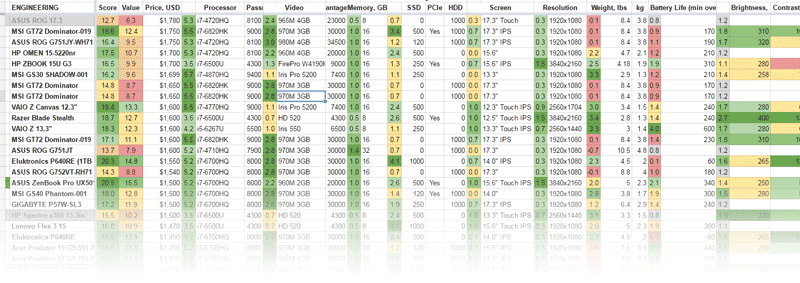
 At the end, I’ll list out 5 best picks when it comes to best laptops for photography. To find them, I went over a 120 hottest laptops and evaluated them using an array of metrics and benchmarks starting from the processor and ending with every important display metric: panel, resolution, brightness, contrast, sRGB/RGB coverage.
 And it gets even more complicated.
 So you are searching for the best laptop for law school? The good news is that you do not need to spend a lot for an OK computer. But if you want the best one for your needs and wallet – there is only a handful of options I can recommend.
 The best laptop for word processing and excel doesn’t mean that should be expensive. At the same time, when brands release entry-level laptops, they are forced to make some strong compromises. And I won’t shock you by saying that some laptops have made very bad ones.
 I’ve been a full-stack web developer for past 4 years and as a laptop-obsessed person, I’m glad whenever I get asked what is the best laptop for web development and programming. That’s because I can recommend the stuff I’d buy instead of going through the regular train of thought of “this would be great for me, but I guess this person won’t need that much RAM/SSD/GHz/etc”. And in this post, I’ll guide you on how I’d choose a laptop for web development and which laptops are the best options right now.
 Lets get this out of the way, there’s no ONE best laptop for teachers. That’s not because I couldn’t find them – don’t worry, I did find some great deals. But there are some unknowns in the equation that only you could know: what are your personal needs and are there any restrictions within your school?
 I can only wish you’re not yet packing your bags while searching for the best laptop for travel. These laptops are not easy to pick as they demand hard compromises between performance and portability. And as any laptop owner knows, with great power comes no battery life. But if you’re in search for both, strap in, I’ve researched this subtle topic so you don’t have to.