Best laptops for Graphic Design (Over 170 laptops compared)

Best laptop for graphic designFirst, we’ll start by figuring out what type of laptop you’re searching. That includes nailing down the your prefered laptop size, priorities when it comes to performance-to-portability ratio and general budget limits.

Then, I’ll cover the most important specs and metrics that are essential for any good graphic design laptop. One by one, I’ll explain their role in our particular case and then what exact specs you should be looking for.

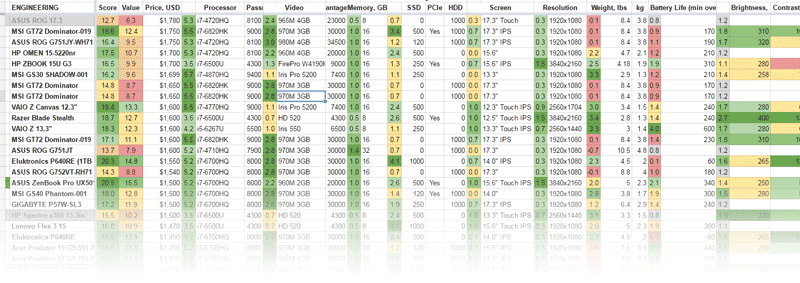
Finally, I show what are the 10 absolute best laptops for graphic design. These notebooks were picked out of a pool of over 170 computers. And in the unlikely event that you don’t fancy a single of my recommended models – I’m giving away the comparison sheet of all 172 compared laptops for free. It is tailored specifically for graphic design so you’ll save hours.

But first things first – what are the requirements for the best laptop for graphic design?

What is crucial to a graphic design laptop?

First of all, to know what kind of laptop will be the best for you, you decide on your budget and preferred screen size.

Size

For simplicity’s sake, I’ll talk about 3 most common laptop sizes: 13″, 15″ and 17″. I apologize for not including 14″, which I know is just in the sweet spot for some graphic designers. But their characteristics can be easily guessed as a mix between 13.3″ and 15.7″ laptops.

Let’s begin with 13-inch notebooks. They are best suited if you need a very portable laptop. It’s the best size for travel due to its excellent portability. But the lack of screen “real estate” is not ideal for any type of visual work.

15″ is the most common option for most people, including graphic designers. 15 inches is the standard size for an office laptop.

17″ the best screen size if you’re searching for a desktop-replacement workstation and you will need to carry it only once in a while.

external-screen
Don’t forget that often there are options for external displays. If you need a small laptop for home and a larger one for office – getting a 13″-15″ notebook with a few ports for display can be enough. So you’re not necessarily limited by a screen size. The number and versions of HDMI, Display Port, USB 3.1 Type C (w/ Thunderbolt III) connections determine the number of screens you can use. 13″ laptops usually can have 1-2 external displays while a standard 17″ behemoth can have ~4 of them.


Continue reading

Best laptop for Architecture: 6 best laptops and how I found them (2017 Autumn Update)

wallpaper of architecture

In the world of architecture, finding the best laptop for the job can be challenging. As someone who has been a part of the industry, I know how frustrating it can be to have to work on a machine that can't keep up with your workload. That's why I created this guide to help you navigate your way through the confusing maze of specifications and technical terms to find the best laptops for architects.

Whether you're an architecture student or a professional, the demands placed on your laptop are high. You need a machine that can run complex design software, manage multiple applications at once, and handle rendering and 3D modeling with ease. With so many different brands and models on the market, it can be tough to know where to begin.

Continue reading

Best laptop for nursing students – 5 Top Picks

Choosing the right laptop as a nursing student2018 September Update. Luckily, nursing students do not need to have some specific requirements for a laptop which make almost any laptop a viable option for the course. At the same time, lack of clear guidelines makes it hard if you’re determined to get the best laptop for nursing students, even if for your own limited budget.

In this post, I’ve taken up the task of researching and comparing a whole lot of hottest laptops (over 400!) to find the best of the best. In essence, I’ve compiled all the relevant information out of a bunch of blog posts, articles, forums and university guidelines with some EXACT requirements for a laptop that are rarely found online.

First off, I’ll start off by examining what an average nursing student needs, describing to the T what you should get, what is not important and where you should make decisions on your own if you want the best laptop specifically for you. At the end, I’ll list out the best laptops for nursing students and what are their strengths and if there are any “gotchas” that you should be aware of.

Let’s begin by defining what we mean by “best laptop for nursing students”.

What is important for a nursing students laptop?

Nurse filling a reportAs a nursing student, you’ll need to deal with office apps, research on the web and, possibly, some domain-specific software (for example, statistical programs). There are some basic requirements online outlining what laptop you’d need for the course:
  • Windows 10 Pro or higher (not Windows RT) or OS X
  • Intel Core i5 or higher
  • 14” HD display or larger
  • Integrated webcam
  • 6 GB memory or higher
  • 250 GB hard drive or larger (solid state recommended)

These are not particularly demanding specs. Let’s go through them one-by-one:

  • Windows laptops and OS X laptops are both fine. That means that Chromebooks are out of the question (according to this particular school which might not always be the case for other colleges/university). Also, explicitly excluding Windows RT means that operating systems found in tablets and some 2-in-1 laptops are not enough.

Performance

Processor

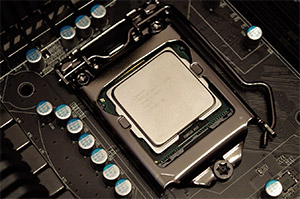
ProcessorNursing students mostly have to deal with basic word processing/excel spreadsheet work, email, web-surfing and occasionally some statistical software. That type of work does not need a good processor. But there are a few types of processors I’d avoid still. First off, all Windows laptops with Celeron and Pentium processors should be ignored for good. Only Chromebooks can function properly on these slow processors but even then I’d suggest going for an Intel Core i3 CPU instead
It is quite easy to know if a laptop has one of these slow CPUs. In short, any Intel processor that is not in Core series (does not have a prefix of i3, i5 or i7 before its model name) – is most likely either a Celeron, Pentium or Atom CPU.

Continue reading

In search for the Best Laptops for Kali Linux

Kali Linux is quickly getting traction as de facto penetration testing suite/OS for professionals and hobbyists alike. But obviously, it is not as popular as mainstream Linux distros like Ubuntu, Mint or Debian. That leaves most of pentesters in the dark when searching for the best laptop for Kali Linux. Up until now, Kali forums are filled with year-old suggestions of buying a Lenovo laptop that’s almost as old as you are. And I won’t lie – in some cases, you might aswell get that refurbished Lenovo. But maybe now is the time to get a something new?

Well, I took on the mission of finding the best Kali Linux laptops and it wasn’t pretty. Apparently, checking laptops one-by-one for their WiFi chipsets is not most fun way to spend my free time.

Now, I will skip the whole “do you really need Kali Linux” part and I’ll assume you have all the reasons in the world to install it and to buy a laptop for it.

Ok, let’s go straight to finding the holy grail of penetration testing – the best laptop for Kali Linux.

Requirements for the best Kali Linux laptop

How much power do you need?

To find the best laptop for penetration testing we need to define what exactly it will be used for.

For the most part, any laptop that runs Linux will work. You don’t need anything fancy when it comes to pentesting laptops. In the most basic sense, if Ubuntu can run on a laptop, Kali can run on it too.

Penetration testing

You could use a Kali Live USB with persistence or dual-boot with Windows (or other Linux distro). Most likely, you’ll also need to have a couple of virtual machines (via Oracle Virtual Box, VMware or Parallels). That only requires a basic processor and a bit extra RAM. You don’t need much for capturing, probing and listening. In that case, you might want to steer away from bulky machines and towards lighter ones if your budget allows it.

Cracking hashes

Using GPU cracking is an entirely another subject. In that case, you’ll need a laptop resembling a gaming rig. Then powerful CPU and GPU will come a long way but even then there some serious issues with GPU cracking on a laptop.

Continue reading

Best Ubuntu Laptop: 9 Top picks for 2017 (April Update)

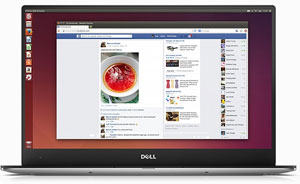
best-laptop-for-UbuntuI will go straight to the point with this one. Find the best Ubuntu laptop is not easy – even finding a good laptop for Windows can take some time. And when we add compatibility issues and varying degrees of Ubuntu support for 15.xx and 16.xx releases, we can find ourselves crossing fingers hoping that the trackpad and WiFi work out-of-the-box.


On the other hand, Ubuntu is the best Linux distro when it comes to finding a compatible laptop. There are plenty of reviews and guides for the most popular guides. Ubuntu community might not have a well-maintained wiki with recent laptops (as ArchLinux does), but there are a lot more easy step-by-step guides for Ubuntu users.

In this lengthy post, I’ll cover what is important when searching for the best laptop for Ubuntu and what are the common problematic areas. Then, I’ll list out the best Ubuntu laptops with guides: best laptops with Ubuntu pre-installed, best Chromebooks for Ubuntu and the best Windows laptops and MacBooks with good Ubuntu support.

What we should look for in an Ubuntu laptop?

First things first. To find the best Ubuntu laptop, we’ll need to know what we’re looking for and what we should avoid. I’ll break down specs one by one and outline what are our options.

Performance

Major Processor

Starting with Kernel 4.3 – found in Ubuntu 16.04 LTS, Linux supports Skylake graphics which are generally superior to their Broadwell and Haswell counterparts. Therefore, unless you have limitations of a particular Ubuntu version, go for the latest Ubuntu release with newest Kernel and a 6th generation Intel CPU.

Apart from that, judging a mobile processor for Linux is quite straightforward.

Continue reading

Best Linux Laptop: What are the top options 2017 (April Update)

I think you understand that finding the best Linux laptop is not as easy as finding a laptop for a particular piece of software or a profession.linux-laptop

A mechanical engineer buying a laptop will at least know that the touchpad, audio, and graphics cards will be working. Anything else wouldn’t be acceptable. But this is not the case for Linux laptops. Even in 2017, there are a lot of issues when trying to stuff most Linux distros into a non-certified laptop. And if you’ve got a Windows laptop or a Chromebook – a problem with Linux is a problem you’ll need to solve.

But searching for the perfect out-of-the-box compatibility is an easy way to leave yourself with just a few options on the table. That’s why, I’m going to look for the laptops that are great overall while maintaining sufficient compatibility with Linux (as in, they have guides showing how to fix any or most of the issues that can occur).

In this post, I’ll start off with the basic prep-work: choosing a distro, what hardware we should avoid and what metrics are most important when in search for the best Linux laptop. Finally, I’ll list out some great options: Chromebooks, Windows laptops and workstations

It’s worth to note, as a programmer, I have a bias for a fast processor, a lot of RAM and SSD. That’s why some of the best Linux laptops for me might not match your needs if you will not be using your laptop for work.

Also, even though I have updated this guide in 2017, I haven’t found any guides on Ubuntu 17.04 so, but there’re a few on 16.04 LTS and 16.10.

Pick a distro upfront

First of all, if you already have made you mind on Linux distro – it will be easier to find a compatible laptop suiting your needs.

And if you haven’t – there are a lot of good Linux distros to choose from. Also, if you’re a user of some classic distro, remember that getting a new laptop can be one of the best times to try out a new flavor of Linux. For example, if you’d like to get a Chromebook for Linux, then GalliumOS (subreddit) could be a nice choice. Or maybe this is the time you’ll finally try out Elementary?

Continue reading

World of Warcraft laptop: Top 6 picks & Laptop Requirements (2018 Battle for Azeroth Update)

Finding the best World of Warcraft laptop depends on your budget and on the visual settings you’re willing to tolerate. Luckily, the core game engine is so old that there’s no need to get top-of-the-line hardware. That should be great news if you’re searching for a WoW laptop under $500.

Laptop for World of Warcraft
World of Warcraft: Legion logo is a trademark of Blizzard Entertainment. Use of it does not imply any affiliation with them.
How am I going to find the best laptops for WoW?

Updated on June 5th, 2018. This time, I’m replacing all laptops with mostly 8th gen Intel processors and Nvidia Pascal graphics.
Updated on March 3rd, 2021. I’ve added an updated guide with laptops for WoW: Shadowlands.

First, I’ll show you what are the exact requirements for a laptop instead of the generic stationary PC-oriented requirements. Then I’ll guide through each of them so you’ll know where you can cut corners and what is an absolute must. Finally, I’ll list out 8 best World of Warcraft laptops in their price ranges starting from $350 and ending with ~$3000.

Official requirements

I’ll begin with Blizzard’s official requirements for Legion. Of course, we could use requirements for Warlords of Draenor but to make matters simple, I’ll assume you’re targeting for your laptop to run well with the latest expansion and with new expansions in the future.

  • Minimum:

    • Intel® Core™ 2 Duo E8500
    • NVIDIA® GeForce® GT 440 / Intel® HD Graphics 5000
  • Recommended:

    • Intel® Core™ i5-3330
    • NVIDIA® GeForce® GTX 750 Ti (5400 3DMark’11) / NVIDIA® GeForce® GT 775M (6000 3DMark’11)

World of Warcraft laptop requirements:

Minimum Requirements Recommended Specifications
Processor Any 4th-7th gen i3, i5 or i7 processor;
AMD A6-5200 or up;
Intel M3-6Y30
i5-6300HQ;
i5-8300H;
i5-8250U;
any 4th-7th gen i7 Q-series processor (i7-4720HQ, i7-5700HQ, i7-6700HQ…);
(this does NOT include i7-*500U CPUs)
Video Any integrated graphics in 5th-7th processor (except generic HD Graphics and HD Graphics 510);
Any dedicated Nvidia graphics card;
AMD Radeon R7/R9 M300 series
Nvidia GTX 960M;
Nvidia GTX 1050;
Nvidia GTX 970M/1060 for high frames above Full HD resolution
Memory 4 GB 8 GB and more

These requirements are NOT official – I used the official requirements to match their recommended components to equivalent laptop parts. I used 3rd party benchmarks including 3DMark and PassMark tests.

Continue reading

Sims 4 laptop: What is the best laptop for Sims 4 (UPDATED)

Sims 4 logo is EA trademark. Use of it does not imply any affiliation with them.
Sims 4 does not necessarily need a very fast laptop. In fact, it is one of the easiest games to pick a laptop for. Of course, if you want to get the best deal, which is exactly tailored to what you’ll need to run Sims 4 – it helps to know what exactly you should be looking for.

To find the best Sims 4 laptop, I went through PC requirements, converted them to equivalent laptop components and what are the precise processors and video cards you should look for. Finally, I’ve picked out 5 best laptops for Sims 4 depending on your budget and the graphics settings you want to play the game on.

To begin with, let’s examine what is important for a Sims 4 laptop.

What are we looking for in a Sims 4 laptop?

Official requirements

First of all, let’s check the official requirements for Sims 4:

  • Processor: 1.8 GHz Intel Core 2 Duo, AMD Athlon 64 Dual-Core 4000+
  • Video card: NVIDIA GeForce 6600 or better
  • Memory: At least 2 GB RAM
  • DVD drive for installations using DVD
  • OS, Sound Card, Hard Drive, DirectX and other requirements are easily met by any modern laptop

There are a few more different 3rd party sources for Sims 4 requirements which can help us to get a better grasp on what should be our target. These are the recommended specs for Sims 4:

  • Processor: Intel Core i5-750
  • Video card: Nvidia GTX 650
  • Memory: At least 4 GB RAM

These system requirements are targeted towards stationary personal computers and not laptops. Now, I’ll adapt these requirements to laptops one-by-one.

Also, we don’t need to worry about Sims 4 expansion packs (Get to Work, Get Together), game packs, stuff packs and other DLC.

The Sims 4 Laptop Mode

Just before we start, I need to address The Sims 4 Laptop Mode. It allows running Sims 4 with very old and weak machines, including some of the cheapest laptops out there. That’s why if you just want to run Sims 4 on the cheap – even the most basic laptop will be enough (more on that in recommendation section).

Continue reading

Best laptop for engineering: Guide & 5 Best laptops

I used to be one of those people that took A LOT of time to find a good laptop. I researched every option, quantified every aspect I could and compared every option in a spreadsheet. I am making it sound as if I don’t do it anymore – actually, I still follow this process for my major purchases since it is the best way. But now, I know what I need to focus and what is non-essential. The same process can be applied when searching for the best laptop for engineering.

In this post, I’ll outline the key qualities and metrics you need to know to get the best deal possible. At the end, I’ll list out the top 5 options that I’ve found out by comparing every laptop on my extensive list of hottest and best selling models.

The laptops are geared towards the “classic engineering”: electrical, mechanical, civil etc.

Engineering laptop comparison

What is needed to get the best engineering student laptop?

For the most part, you can’t expect your university to give precise guidelines to an engineering laptop. Even if your college website gives a description of what laptop you need – they make it sound as if any laptop that has a screen and a processor made in the 2000s should be just fine. At the same time, some websites recommend workstation notebooks which are way over most students budget. These machines are needed only if you’re already a professional. But if you get a professional workstation now and you do not intend to fully utilize it right now – it’s a waste of money that could be put better elsewhere.

Performance and speed

Major requirementProcessor

Here are the processors you should expect at every price range:

Price range Processors
$300 – $700 i3, i5 processors:
i5-4210U, i5-4300U, i5-4210H, i3-5010U, i3-6100U, i5-6200U
$700 – $900 i7 U processors:
i7-5500U, i7-6500U
$900 – $1,600 i7 HQ processors:
i7-4712HQ, i7-4720HQ, i7-5700HQ, i7-6700HQ
$1,600 and up i7 high-end HQ/HK processors:
i7-6820HK, i7-4770HQ

Remember that the higher you go on the processor ladder, the shorter battery life you’ll get. That’s why you might not want to go up to the most powerful processors in i7 x800 or x900 lines.

2 processors that dominate the laptop market right now are:

  • i7-6500U – ($700 and up) above average performance and good battery runtime
  • i7-6700HQ – ($960 and up) very good performance and shorter battery runtime

Any processor in i7 series and some higher-end i5 processors is fast enough for engineering students.

Continue reading

Best laptop for Photography: Complete guide an 5 best picks

The best laptop for photography should have a good balance of performance (for editing), high-quality screen and portability.

In the next 5 minutes, I will cover all bases that need to be addressed to pick your own best laptop for photography. I will also list out what you should expect at various price ranges.

A good laptop for a photographerAt the end, I’ll list out 5 best picks when it comes to best laptops for photography. To find them, I went over a 120 hottest laptops and evaluated them using an array of metrics and benchmarks starting from the processor and ending with every important display metric: panel, resolution, brightness, contrast, sRGB/RGB coverage.

Requirements for the best laptop for photography

I have conveniently split requirements into 3 groups: 3 Major, 3 Minor, and a single Optional demand. Depending on your personal needs, these can be re-ordered or even thrown out. But most could blindly stick with these exact requirements without risking of making a wrong choice.

What is critical for photography laptop?

Major requirement A lot of storage (fast) space

Types of drives

Whenever you’re checking out a laptop, one of the very first you should look at is its storage type. There are 2 most general types of storage and a few options in-between.

First and foremost, SSD is the king when it comes to storage drives. It is the single most impactful advance when it comes to consumer computer parts in the past 10 years. That’s because they’re head and shoulders above the older HDD drives. Solid State Drives are tremendously faster, they consume less power and they do not degrade in performance as HDDs do. But there is one very relevant caveat when it comes to these drives – their price. SSDs are quite a bit cheaper when looking at their price tags from a few years back but they’re still a lot more expensive than their HDD counterparts.

2000 GB

Storage size
Type 500 GB 1000 GB
HDD $35 $55 $95
SSD $200 $400 $850

Not surprisingly, a complete opposite could be said about Hard Drive Disks. They are redundantly cheap and best suited for long-term storage. If you are searching for a stationary computer – this would be the end of the story when it comes to drives. Get 500 GB in SSD for the system, photo editing apps and your recent pictures. Then, add 2 TB in HDD for image archives and forget about all storage limits.

The reason why this won’t (usually) work for laptops stems from their size limits. Only 17.3″ owners could brag about their 3 or 4 installed drives. Now, many 15-inch notebooks have very limited options for additional storage. Most likely, they have 1 drive slot and mSATA or M.2 connection. In some cases, manufacturers, striving for ever slimmer and lighter laptops, completely moved to M.2 drives which are only suitable for SSDs.

At the end of the day, you need to choose:

  • A lot of cheap and slow storage
  • A small-ish SSD and a spacious HDD in a 15″-17″ laptop
  • A large SSD in an expensive laptop
What to expect
13.3″ 15.6″ 17.3″
Under $1000 250 GB SSD 250 GB SSD + 1 TB HDD 250 GB SSD + 1 TB HDD
Under $1500 500 GB SSD 500 GB SSD + 1 TB HDD 500 GB SSD + 1 TB HDD
Over $1500 500 GB SSD 500 GB SSD + 1 TB HDD 500 TB SSD + 1 TB HDD

One more thing, you could get a small external drive over USB 3.0 later down the road, when you’ll be certain that you need one. UBS 3.0 drives are sufficiently fast to not notice a difference. There’s always a cloud storage option, but I would only use them for back-ups. Even with a 100 Mbps internet, they’re still not convenient at all when working with high-resolution RAW images.

Continue reading